Reflections on Holy Thursday

I have begun to feel increasingly troubled by the videos sometimes presented by our church clergy or young altar servants, which offer explanations of the meaning of Holy Week. The idea is commendable, but what troubles me is the incomplete explanation given about Holy Thursday.
According to some of these videos, Holy Thursday is important because, in the morning, the Order of the Penitents takes place; in the afternoon, the Washing of the Feet ceremony takes place; and at night, the Service of the Passion. In this proposed list, the Divine Liturgy is completely absent, and this in itself is an indication of a more concerning phenomenon.
The Washing of the Feet and the Service of the Passion are relatively more popular for the members of the Armenian Apostolic Church members because, in the washing of the feet, the mystery of Christ’s humility is presented in a dramatic way, while also recalling Christ’s command that He gave us an example of humility and instructed us to do the same for one another. As for the Tanabree, the seven Gospel readings, the yarn and the knots, along with the hymn “Where Are You, My Mother?”, create a deeply emotional atmosphere of prayer and reflection.
However, the Order of the Penitents, which is a service comprised of the Mid-Day (Jashoo Jam) and the Evening Service and takes place before the Divine Liturgy on Holy Thursday, is not perceived in the same way. Some mistakenly say that its function is to grant absolution to the faithful coming out of the forty-day fast. But this is not a convincing explanation, because on the previous Sunday, Palm Sunday, everyone could receive Holy Communion after receiving absolution during the Divine Liturgy.
The meaning of the Order of the Penitents is found within the service itself. The hymns sung there speak about Christ’s sacrifice. For example, the final verse of the Blessing (Orhnoutyoun) hymn says: “Today we were renewed again from the curse of the forefather, by tasting the body and blood of the Son of God.” The same idea is conveyed in the hymn of the Fathers, “Harts.”
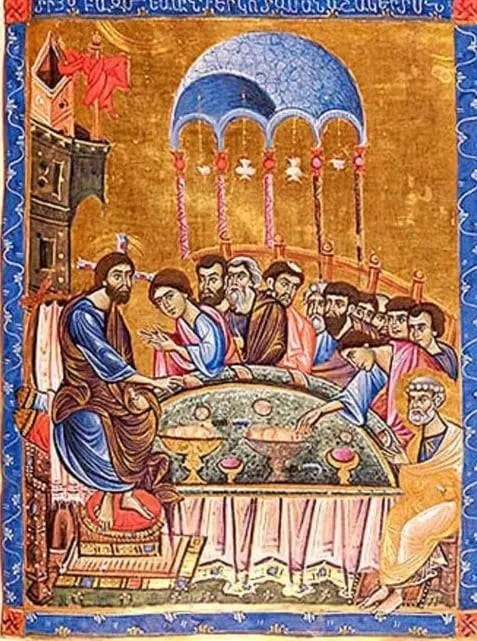
The Order of the Penitents is connected to the Divine Liturgy, which is bridged through the Evening Service and the Scripture readings. Within these services, there are two notable elements. The first is three long prayers, two of which belong to St. Basil of Caesarea, and another, between them, belonging to St. John Chrysostom. These prayers have deep theological meaning and address the sin of Adam, fallen humanity, and God’s mercy revealed through the crucifixion of Christ as a sacrifice for the salvation of our sins. St. Basil writes in greater detail about Holy Communion, emphasizing that it is the Body and Blood of God given to us. The second element is the scriptural readings. The Gospel readings, taken from Mark and Matthew, present Christ’s Last Supper, where Jesus breaks the bread and gives it to His disciples as His Body, and blesses the wine and gives it as His Blood, instructing them to do the same in remembrance of Him.
The readings before the Gospel are as follows: before the reading from Mark, passages from Isaiah 61:1–7 and Acts 1:15–26 are read. These selections show that, according to the prophet Isaiah, the Savior, filled with the Spirit of the Lord, will bring salvation and that new priests will serve God. The reading from Acts tells us how Matthias replaces Judas so that the number of twelve remains intact. Before the Gospel reading from Matthew in the Divine Liturgy, a passage from Paul’s First Epistle to the Corinthians is read, in which the Apostle explains how the early Christian Church celebrated the Divine Liturgy in its original form.
All of this shows us that the most important mystery of Holy Thursday is that the Church commemorates the institution of the Divine Liturgy, Holy Communion, and the new priesthood. These profound messages are hidden within the hymns, prayers, and scriptural readings of our Church. When our faith remains superficial, we see only the washing of the feet and the service of the Passion. But when we go deeper into our spiritual life, then we see that on Holy Thursday Christ’s words, “Take, eat…” and “Drink of this, all of you…” give meaning to Christ’s crucifixion on Good Friday. Through this, believers look upon the Cross not as an unjust execution, but as the greatest symbol of God’s love for humanity.
The Evangelist Luke tells us the story of the disciples on the road to Emmaus. As they walk, they encounter Jesus but do not recognize Him. However, when they sit at the table with Him, and Jesus breaks the bread, their eyes are opened, and they recognize Christ.
Today, we too have begun not to recognize Christ, like those disciples. Yet Christ invites us to His table so that we may not only recognize Him, but also receive Him into our hearts through Holy Communion.